The Story of Indian Coffee Doesn't Start and End in Karnataka
Ask most people where Indian coffee comes from and they'll say Coorg or Chikmagalur. They're not wrong. Karnataka alone produces over 70% of India's coffee, and these two names have defined how the world thinks about Indian beans for decades.
But here's what most people don't know: India's coffee story is far bigger, far wilder, and far more exciting than just the Western Ghats.
India's coffee-growing landscape spans 13 distinct agro-climatic zones, spread across traditional regions in the south, non-traditional belts in the east, and a growing network of northeastern states. From tribal highlands in Odisha to cloud-wrapped hills in Nagaland, a quiet revolution is reshaping what Indian coffee means to the world.
At Bean by Nation, our entire philosophy is built on this idea - that great coffee grows in every corner of the world, and most of it is still undiscovered. Here's your guide to India's most exciting hidden coffee regions.
Frequently Asked Questions About India's Coffee Regions
Which states in India grow coffee besides Karnataka?
India grows coffee across a surprisingly wide geography. Beyond Karnataka, emerging growing regions in northeastern India - including Assam, Meghalaya, Manipur, Mizoram, and Nagaland - alongside tribal belt states like Odisha and Andhra Pradesh, are increasingly attracting specialty buyer attention for their unique terroir and smallholder traceability.
Does India have GI-tagged coffees beyond Coorg and Chikmagalur?
Yes. India holds GI tags for five regional coffees: Coorg Arabica, Wayanad Robusta, Chikmagalur Arabica, Araku Valley Arabica, and Bababudangiris Arabica. Monsooned Malabar Robusta has also received GI certification. Nagaland is currently working toward its own GI tag - a recognition that would be a landmark moment for Northeast Indian coffee.
How big is India's specialty coffee export market?
India has emerged as the fifth-largest coffee exporter globally, with exports reaching a record USD 1.8 billion in FY 2024–25 - a 40% growth from the previous year. Much of this growth is being powered by rising demand for India's specialty and single origin coffees.
1. Nagaland - The Most Exciting Origin in India Right Now
If there's one region that captures everything Bean by Nation stands for, it's Nagaland.
Coffee was first introduced to Nagaland in 1981 by the Coffee Board of India. It only began to take off after 2014. Today, Nagaland has almost 250 coffee farms spread across 10,700 hectares of land in 11 districts, with about 9,500 farmers engaged in coffee cultivation.
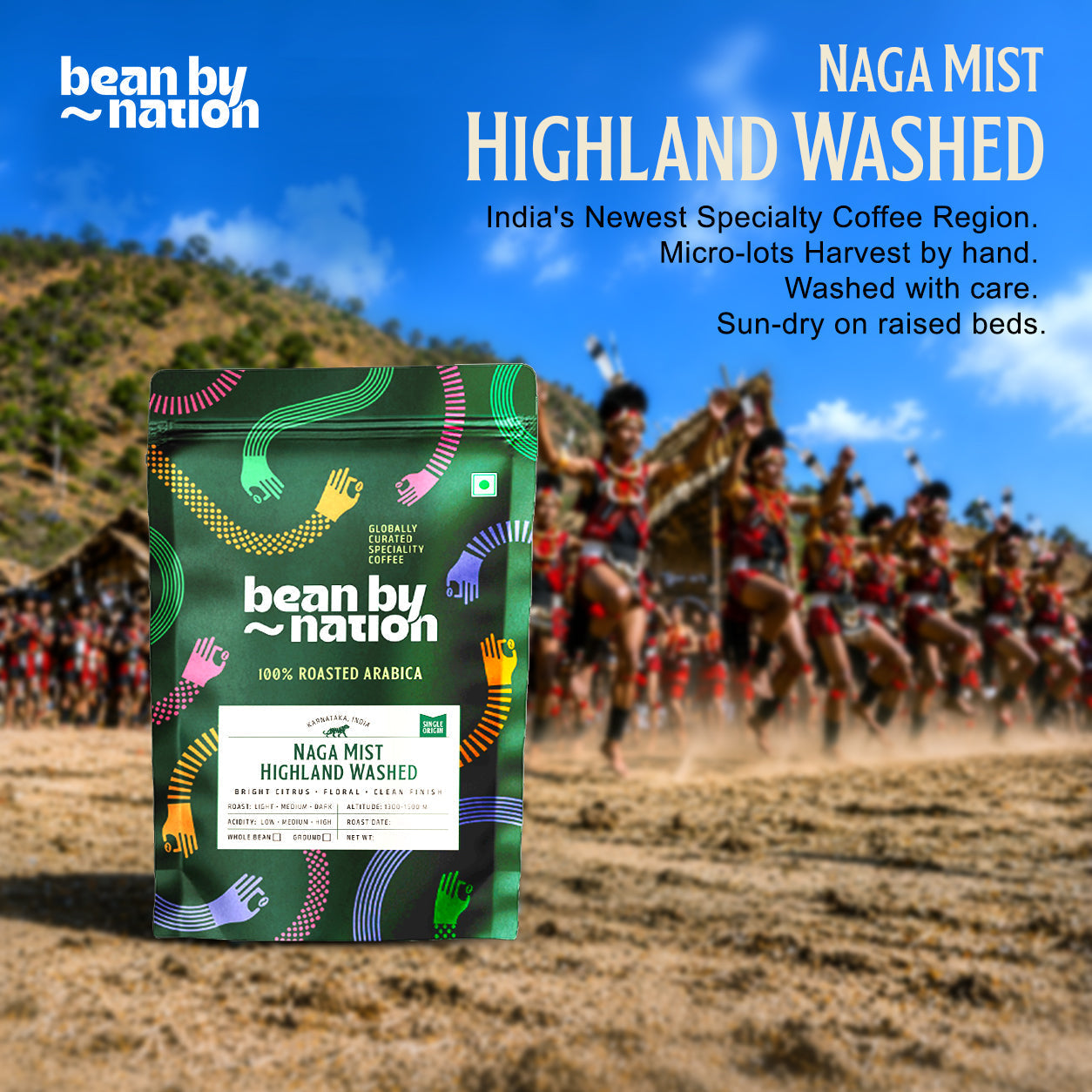
Grown above 5,500 feet in the mist-covered highlands of Northeast India, Naga coffee has a character unlike anything from the south. Our own Naga Mist Highland Washed Coffee - bright citrus, floral, with a clean finish - is the clearest expression of what these hills are capable of.
And the world is starting to notice. Naga coffee won silver at the Aurora International Taste Challenge in South Africa in 2022, and then gold in 2023.
Entrepreneurs in Nagaland hope that speciality coffee from the state will soon receive a GI tag, similar to varieties from Coorg, Chikmagalur, Araku Valley, and Wayanad. When that happens, it will mark Nagaland's arrival on the global specialty coffee map — not as a footnote, but as a headline.
Flavour profile: Bright citrus · Floral · Clean finish · Bold and wild
Altitude: 1,500–1,900 metres (5,500ft+)
Try it: Naga Mist Highland Washed – Bean by Nation
2. Araku Valley, Andhra Pradesh - Tribal Coffee, World-Class Quality
Situated in the Eastern Ghats of Andhra Pradesh, Araku Valley has rapidly gained international attention for its clean, high-grown coffees cultivated by tribal farming communities.
What makes Araku remarkable isn't just its flavour - it's its model. The coffee is grown organically, managed through women-led cooperatives, and deeply tied to community welfare. Approximately 90% of the Araku coffee produced is exported to other countries, significantly contributing to India's coffee exports and strengthening the local economy.
Produced at elevations of 900-1,200 metres, Araku coffee often features fruity and wine-like notes, placing it in demand with third-wave roasters. The emphasis on organic cultivation and community-driven models adds social and ethical value, making it highly marketable in Europe and the US.
Flavour profile: Fruity · Wine-like · Chocolatey · Clean
Altitude: 900–1,200 metres
What makes it special: 100% organic, tribal farming communities, international award winner
3. Koraput, Odisha - The Hidden Gem of the Eastern Ghats
If Araku is Andhra Pradesh's open secret, Koraput is Odisha's quietly brewing revelation.
High altitude and cool climate give Koraput coffee a mild, smooth taste with subtle fruity and nutty notes — a hidden gem in India's coffee landscape. Most of the farmers here are smallholder tribal communities, growing forest-shade coffee using sustainable, chemical-free methods.
Koraput Coffee won two Fine Cup Awards at KYK 2024, one each for the washed process and natural process categories - recognition that has firmly positioned Koraput on India's specialty coffee map.
This is exactly the kind of origin Bean by Nation exists to bring to your cup.
Flavour profile: Mild · Smooth · Subtle fruit and nut notes
What makes it special: Award-winning tribal coffee, forest-grown, dual-process excellence
4. Wayanad, Kerala - The Underrated Robusta Capital
Wayanad is a district in Kerala's Western Ghats that produces most of the state's coffee — between 50,000 and 60,000 metric tonnes annually. Its coffees carry hints of berries and a chocolate flavour profile.
While Kerala as a whole is best known for Robusta, Wayanad's beans have earned a GI tag of their own. Wayanad Robusta is acclaimed for its smooth, full-bodied flavour and is commonly used in espresso blends. But a new wave of specialty producers in the region is experimenting with honey and washed processing, creating small-batch Wayanad lots that bear little resemblance to commodity Robusta.
Flavour profile: Berry · Dark chocolate · Full-bodied
GI Status: Yes - Wayanad Robusta is GI-certified
What makes it special: India's premium Robusta, increasingly specialty-processed
5. The Nilgiris & Yercaud, Tamil Nadu - Altitude, Clarity, Elegance
Tamil Nadu holds about 5–7% of India's coffee production, but punches far above its weight in quality.
Yercaud, located in Tamil Nadu's Shevaroy Hills, is an emerging specialty origin characterised by mineral-rich volcanic soil and innovative processing - ideal for light roast enthusiasts who value clarity.
The Nilgiris, straddling the border of Tamil Nadu, Kerala, and Karnataka, produce both Arabica and Robusta at elevations that deliver floral, aromatic cups. These are coffees that reward a pour-over setup - slow, deliberate, elegant.
Flavour profile: Floral · Aromatic · Bright acidity · Clean
Altitude: High - Nilgiri Hills and Shevaroy Hills
Best brew method: Pour Over, V60
6. Northeast India's Emerging Coffee Belt — The '7 Sisters' Are Waking Up
Beyond Nagaland, the entire Northeast is quietly stepping into India's coffee story.
Northeastern states with active government-supported coffee cultivation programmes are collectively part of India's ambition to develop a '7 Sisters' coffee region with specialty export potential.
Manipur has over 240 hectares of land cultivating Arabica coffee. Manipur coffee is described for its light body and fine aroma, with a sweet and fruity flavour profile that intrigues specialty coffee lovers.
The North Eastern states attract international buyers with their small-batch specialty lots, standing out for their clean cup profiles, bright acidity, and unique flavours — often linked to the region's rich biodiversity and traditional farming methods.
These are coffees at the very beginning of their story. And the beginning is always the most exciting part.
Why India's Hidden Coffee Regions Matter
The global specialty coffee conversation is shifting. Consumers no longer just want to know what they're drinking - they want to know where it came from, who grew it, and what it stands for.
India's hidden coffee regions offer all three answers with rare depth:
Biodiversity: India is unique in that 98% of its coffee is shade-grown under tall trees and dense forest canopies - plantations that are ecologically rich, home to elephants, bison, leopards, and hundreds of bird species.
Scale of impact: India's coffee supports over two million people across farming communities - many of them tribal, many of them women-led.
Flavour diversity: From the bold wildness of Nagaland to the clean fruitiness of Koraput to the chocolate depth of Wayanad, India's hidden regions offer a flavour map that rivals any origin on earth.
Bean by Nation: Curating India's Next Chapter in Coffee
At Bean by Nation, we don't just sell coffee from the names everyone already knows. We go looking for the origins that haven't had their moment yet - the hills, the tribes, the farmers, the terroir that the world is only just beginning to discover.
Our Naga Mist Highland Washed Coffee is one expression of that mission. But it won't be the last.
If you've only ever tasted Coorg and Chikmagalur, you've tasted India's history. The rest of India's coffee story is still being written - and it's going to be extraordinary.
Explore India's finest single origin coffees → beanbynation.com
Related Reading on Bean by Nation
- Naga Mist Highland Washed Coffee – The Full Story
- What Is Single Origin Coffee and Why Does It Matter?
- Washed vs Natural Process: What's the Difference?
- Explore Our Full Single Origin Coffee Collection
- About Bean by Nation – Why We Curate by Nation
Bean by Nation — Globally Curated Speciality Coffee.
Single Origin. Handpicked. From hills most people haven't heard of yet.